Woodblock Prints
I have always been fascinated with Japanese woodblock prints and printing. Ukiyo-e or "pictures of the floating world" were woodblock prints designed and printed during the Edo period in Japan (1603-1867) and depicted scenes of everyday life. Then came the Shin hanga period from around 1915-1942 and again in the 1950s and 60s after World War II, which revived the traditional woodblock printing in Japan. Shin hanga or "new prints" combined traditional themes with modern elements and pigments, creating a international appeal for Japanese woodblock prints. Traditional ukiyo-e prints were done by three artisans, the Eshi (designer), Horishi (block carver), and the Surishi (printer). In the twentieth century came Sosaku hanga or "creative prints" a term used in Japan for those prints created entirely by one person from conception to finished product, which is what I am attempting to accomplish with my woodblock prints. As you can see my first attempt is relativity simple a one color design using negative space to help create the image. Moving forward I plan to carve multiple blocks and use several colors for a series I am calling "Eight Views of the Western United States". I will post the progress of this series on my "Upcoming Events" page. I hope you enjoy.
PANDA
My first woodblock design. A simple sumi ink panda bear. I used a block of basswood to carve the image. The finished print is on Kozo paper from Thailand. The paper dimension is 6 x 9. The image below has been matted.

TORI (Bird)
My first color print is not going as well as planned. Needing to take a break and re-evaluate the process, I decided to carve and print a bird. I took a copperplate image from Bijutsu Gafu: Kachō Sansui, published by Kunshidō in Meiji 23 (1890). I embellished the design by adding more rock, foliage, and changed the bird. I tried to make it look rustic in appearance by leaving a gap in the rectangle outline and rubbing lightly with the baren to hopefully create some lighter surface areas. The carving and printing was done all in one day. It is sumi ink on Awagami Shiramine Select paper. The paper dimension is 5 x 7. This image has been cropped. There is an approximate 5/8" border around the entire image.

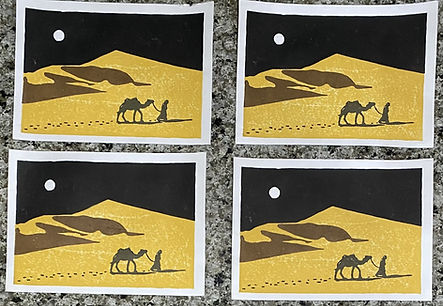
Moonlight
An original design of a nomadic Bedouin crossing the desert at night by the light of the moon. Who knows maybe he is on his way to Rahat. The image is on a 5 x 7 piece of Shin Torinoko washi. Using Holbein pigment paste and sumi ink.
Crow in the Rising Sun
The image of the crow itself was embellished from an image found in Kyosai's Treatise on Painting, printed Meiji 20 (1877). The design is not all that original, I have seen several depictions of a crow with a rising sun motif, this is my interpretation. The image is on a 5 x 7 piece of Shin Torinoko washi. Using Holbein pigment paste and sumi ink.

Turtle Bay, Oahu
This print is from a photo I took back in 2008 at Turtle Bay on the north shore of Oahu. It was done using four different shades of the color blue. The image is on a 5 x 7 piece of Shin Torinoko washi. Using Holbein pigment paste, Winsor & Newton watercolor, and sumi ink.

Eight Views of the Western United States
Below you will find the concept art as I create them for the upcoming series Eight Views of the Western United States. Progress of the carving and print process will be posted on the Upcoming Events page. Please enjoy.
# 1 Arches National Park (Concept Art)
Delicate Arch - is one of over two-thousand sandstone arches located within Arches National Park near Moab, Utah. It is one of the most famous and recognized arches within the park. Every year the park receives more than a million and a half visitors. Making Delicate Arch one of the western United States most scenic views. Please enjoy.

# 2 Bryce Canyon National Park (Concept Art)
Bryce Canyon National Park is also located in Utah near the eastern edge of the Paunsaugunt Plateau. The park is known for its unique amphitheaters filled with colorful hoodoos (rock spires, formed by frost weathering and stream erosion of the river). Every year the park receives more than two million visitors. Making Bryce Canyon National Park a go to scenic destination.

# 3 Grand Canyon National Park (Concept Art)
The Grand Canyon was designated a World Heritage Site by UNESCO in 1979. The south entrance into the park is located near the town of Williams, Arizona. Each year more than four million patrons visit the park to view the shear magnitude of the park's iconic gorge. Some however will make the arduous trek down to the base of the gorge and dip their toe into the Colorado River. Every year an estimated twenty-five thousand adventurous types brave the white water of the Colorado River and traverse the rapids through the gorge. The Grand Canyon is considered one of the natural wonders of the world and one of the American West's greatest scenic views.

# 4 Lake Mead National Recreational Area (Concept Art)
Lake Mead is the largest and man-made reservoir in the United States. It is home to Hoover Dam. At peak capacity Lake Mead can hold 9.3 trillion gallons of water at a depth up to 523 feet. It spans 110 miles and at capacity has a shoreline of 759 miles. Fun fact there is a Boeing B-29 Superfortress Bomber at the bottom of Lake Mead, it crashed into the lake on July 21st, 1948. The view of Lake Mead in this concept art is from the historic railroad trail that traverses 3 miles on the southwest end of the Lake. The railroad was used to hall materials during the construction of Hoover Dam.
